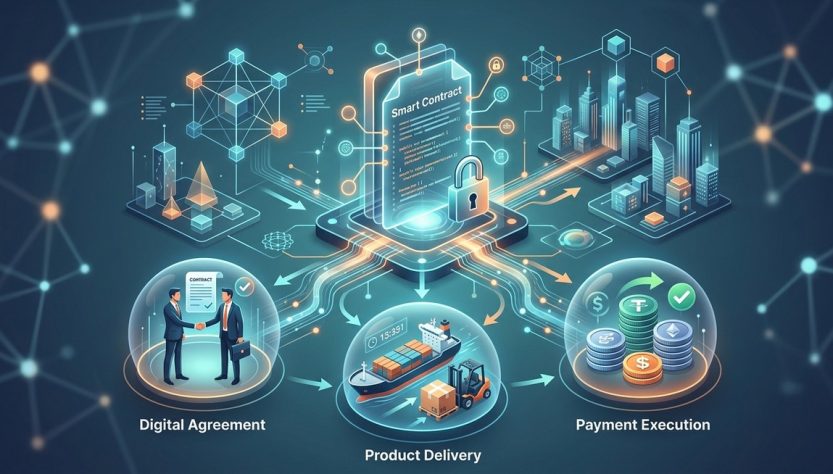
Imagine a world where agreements execute themselves. A supplier ships a container of goods. The moment the shipment tracking system confirms arrival at the port, a payment instantly releases. No invoice to chase. No bank waiting on approvals. No disputes about whether the goods arrived on time.
That world is here today. It runs on smart contracts.
Smart contracts are self executing programs stored on a blockchain. They automatically enforce and execute the terms of an agreement when predetermined conditions are met. Think of them as digital vending machines. You put in the right conditions, and the outcome comes out automatically, without needing a middleman to push the button.
For business professionals looking to cut operational drag, automate repetitive workflows, and build trust with partners, smart contracts offer a powerful shift. They turn manual processes into programmable logic. And they are becoming a core part of how companies in Southeast Asia and around the world handle payments, supply chains, insurance, and compliance.
Smart contracts are not just for crypto enthusiasts. They are practical tools that businesses can use to automate payments, enforce agreements, and reduce reliance on intermediaries. By embedding business rules directly into code on a blockchain, you remove manual steps, cut costs, and gain real time visibility. The technology has matured enough that enterprises in logistics, finance, and real estate are already using it at scale.
What Makes a Smart Contract Different from a Traditional Contract?
A traditional contract is a document. It describes what each party agrees to do, but it relies on people and legal systems to enforce it. If someone breaks a promise, you might need a lawyer, a court, and months of back and forth.
A smart contract is code. The terms are written in a programming language and deployed on a blockchain. When conditions are met, the code runs automatically. No one can stop it or alter it after deployment. This is where the power of automation comes in.
| Feature | Traditional Contract | Smart Contract |
|---|---|---|
| Form | Paper or PDF document | Code on a blockchain |
| Enforcement | Courts, lawyers, manual follow up | Automatic execution by the network |
| Speed | Days to weeks | Seconds to minutes (once conditions verified) |
| Cost | Legal fees, administrative overhead | Network transaction fees (often cents) |
| Trust | Requires trust in the other party plus enforcers | Trust in the code and the blockchain consensus |
The table shows a clear shift. Smart contracts remove the friction that slows down business processes.
How Do Smart Contracts Automate Business Processes?
Smart contracts work on an “if / when … then” logic. You define the trigger conditions and the outcomes. The blockchain acts as a neutral, tamper proof computer that checks the conditions and executes the results.
Here is a simple example to ground the concept:
A freelance platform uses a smart contract for project payments. The client deposits funds into the contract. The contract holds them. When the freelancer submits the work and the client confirms it (both via digital signatures), the contract automatically releases payment. If the client never confirms within 30 days, the contract releases the funds to the freelancer anyway. No one has to chase anyone.
This pattern applies across many business scenarios. Below are three specific processes that smart contracts can automate.
1. Automating Supplier Payments in Supply Chains
Supply chains often involve multiple parties, complex payment terms, and delays. A smart contract can link to IoT sensors and shipping data to trigger payments when goods reach specific milestones.
- Goods leave the warehouse: GPS data triggers a partial payment.
- Goods arrive at the port: a check in from the shipping line releases another portion.
- Customs clearance is verified: final payment releases.
The result is a smoother cash flow for suppliers and fewer disputes for buyers. If you want to understand the underlying technology better, read our guide on how distributed ledgers actually work.
2. Streamlining Insurance Claims
Insurance claims are notorious for paperwork and back and forth. A parametric insurance contract uses real world data to pay out automatically. For example, a farmer buys a crop insurance policy structured as a smart contract. If a weather oracle reports that rainfall in their region fell below a threshold, the contract calculates the payout and sends funds to the farmer’s account within hours, not months.
This kind of automation is already being tested by insurers in Singapore and across Asia. It reduces fraud and cuts administrative costs for everyone.
3. Enabling Royalty Distributions for Creators
Artists, musicians, and content creators often struggle to collect royalties. A smart contract can split revenue every time a digital asset is sold. The contract holds the purchase price and immediately distributes shares to the creator, the label, and the distributor based on predefined percentages. Every transaction is transparent and automatic.
Key Benefits of Using Smart Contracts for Business Automation
Companies that adopt smart contracts see several measurable advantages.
- Faster execution: Transactions settle in minutes instead of days.
- Lower costs: Removing intermediaries reduces fees for lawyers, banks, and brokers.
- Fewer errors: Code executes the same way every time, reducing human mistakes.
- Greater transparency: All parties can see the contract and its status on the blockchain.
- Built in audit trail: Every action is recorded permanently, making compliance simpler.
“In our experience, the biggest win for enterprises is not just the cost savings. It is the speed of trust. Smart contracts let you do business with someone you have never met, without spending weeks on due diligence and contracts.” – Rajesh K., blockchain consultant at a Singapore based DLT advisory firm
A Numbered Checklist for Implementing Smart Contracts in Your Organization
If you are considering a smart contract pilot, here is a practical sequence of steps.
-
Identify a process with clear rules: Choose a workflow that has simple yes/no conditions and measurable outcomes. Payment upon delivery is a good candidate. Avoid processes that require subjective judgment.
-
Map the existing workflow: Document every step, every party, and every data source. Understand where the friction is.
-
Select a blockchain platform: For enterprise use, private or permissioned blockchains like Hyperledger Fabric are common. Public chains like Ethereum are also used, but you must consider privacy and transaction costs. Learn about public vs private blockchains to decide.
-
Design the smart contract logic: Write the conditions and outcomes in code. This is best done by an experienced developer or a smart contract auditor.
-
Integrate external data sources: Many smart contracts need real world data (weather, shipment status, currency rates). Use oracles to bridge the blockchain and the outside world.
-
Test thoroughly on a testnet: Run simulations to find bugs and edge cases. Mistakes in smart contracts can be expensive because they are hard to reverse.
-
Deploy and monitor: After testing, deploy on the main network. Set up monitoring to track contract activity and gas costs.
-
Plan for upgrades: Smart contracts are immutable, but you can use proxy patterns to upgrade logic without losing state. This requires careful design from the start.
For a deeper technical look, see our article on how smart contracts actually execute on the Ethereum Virtual Machine.
Common Mistakes to Avoid When Automating with Smart Contracts
Even experienced teams can stumble. Here are pitfalls to watch for.
| Mistake | Why It Hurts | How to Avoid |
|---|---|---|
| Writing vague conditions | Code cannot interpret “reasonable time” or “good faith”. Use exact numbers and timestamps. | Define all conditions as binary, measurable triggers. |
| Ignoring oracle reliability | If your data source fails, your contract may execute incorrectly. | Use multiple oracles or a decentralized oracle network. |
| Skipping security audits | A single bug can drain funds or lock assets permanently. | Always get a professional audit from a reputable firm. |
| Forgetting about gas costs | On public blockchains, every computation costs gas. Complex contracts become expensive. | Optimize code and consider using Layer 2 solutions. |
| Assuming immutability is always good | If a bug is found, you cannot patch it without a migration. | Use proxy upgrade patterns and test extensively first. |
These mistakes are common but avoidable. Many are covered in our article on 7 critical vulnerabilities every smart contract auditor looks for.
Building a Business Case for Smart Contract Automation
To get buy in from your stakeholders, focus on concrete ROI. Start with a pilot that solves a clear pain point. For example, a distributor spending thousands of dollars each month on manual invoice processing and dispute resolution. A smart contract that automates payments on delivery can eliminate those costs and speed up cash conversion cycles.
Measure the impact:
- Time saved per transaction.
- Reduction in overdue payments.
- Decrease in errors and disputes.
- Lower third party fees.
Once you have pilot results, scale to other departments. The technology is not a magic bullet, but when applied to the right processes, it delivers real operational improvements.
The Path Forward for Smart Contract Adoption in 2026
Smart contracts are no longer experimental. Enterprises across Southeast Asia, from banks in Singapore to logistics firms in Malaysia, are deploying them in production. The regulatory environment is also maturing. Singapore’s Monetary Authority has issued clear guidelines on digital assets and smart contract based financial products.
If your business involves repeated transactions, multi party agreements, or cross border payments, smart contracts can automate the heavy lifting. You do not need to be a blockchain expert to benefit, but you do need to partner with someone who understands the technology and your business context.
Start small. Pick one process. Test it. Learn from the results. Then expand.
The future of business automation runs on code that keeps its promises. Smart contracts make that future a reality today.